Friday, November 5, 2010

Cars and Trains

Filling in with some background information during a letter-writing hiatus from October 6 to November 9, 1949, as June recuperates at the hospital from a ruptured appendix…

At the start of his correspondence with June in early October, Art’s car is in the garage for repairs.  This was probably due to hitting a deer on the way home from visiting June in Riverhead.  We know that this incident occurred sometime during 1949-51 and it seems to match up with the references in the letters.  The car was pretty banged up but survived.  The deer didn’t.

Art's Nash.
Art had purchased his Nash shortly after returning to Southampton from his service in the Navy.  When his parents’ car was in for repair, Art’s car would become the family car.  When his own car was in for repair, he had to improvise other ways of getting around.  Fortunately, his job at Roulston’s was within easy walking distance – about a mile stroll from Cooper Street to Main Street.

Trains are the other mode of transportation that figures prominently in June and Art’s relationship.  While her parents would drive June to the city at the beginning of the semester, June’s weekend visits were done via train.  The Long Island Rail Road had a station just four blocks from the house in Riverhead.  The train ride into the city was approximately two hours.  It could be very cold in winter, but otherwise was an efficient way of bridging June’s two worlds.

(On Sunday, the world of 1949…)

Countdown:  Correspondence resumes in 4 days.

© 2010 Lee Price

Wednesday, November 3, 2010

Didn't you vote?

(I'll share the full letter next week, but couldn't resist posting this now.)

Nov. 10, 1949

Dear Art,

...

What’s the matter?  Didn’t you vote?  The Democrats got in all over!

...

All my love,

June

(On Friday, cars and trains…)

Countdown:  Correspondence resumes in 6 days.

© 2010 Lee Price

Tuesday, November 2, 2010

The Boys

Postcard of Main Street, Southampton.

Considering the subdued and abstemious nature of his family home, it’s mildly surprising that Art gravitated toward a wilder crowd when he went out at nights.  For the most part, he easily settled back into the calmer rhythms of Southampton following his time in the Navy.  But he had seen things in Shanghai and the Philippines that he had never imagined in his sheltered life in Southampton and the experience may have left him a little restless.

When Art went out at nights, he would usually meet up with his friends (called “the boys” in the letters) at various local bars.  If there was a party in town, someone in his circle would be sure to know.  These would be parties among the local residents – not the summer people.  There was little connection between the permanent residents and the Gatsby-like revels of the summer people.

Pen and ink drawing of
wine bottle by Art Price
for Pardita art class.
Joe Cerullo and Bruno Marcincuk were Art’s two closest friends at this time.  Bruno worked with Art at Roulston’s.  Other friends included Frank Hoffman, Jack Raynor, Walter “Singer” Hoinski, and Frank “Farmer” Stachecki.

June frequently expresses concern in the letters about Art drinking too much.  By nature, Art was not a heavy drinker but June’s concern was somewhat justified because there was much heavy drinking going on in the crowd that they ran in.  Art tended to be the reliable somewhat-more-sober one who might be tapped to drive friends home after a long night.

(On Wednesday, June on voting…)

Countdown:  Correspondence resumes in 7 days.

Monday, November 1, 2010

The first New York apartment


During the school year before she met Art (and for one month in October 1949), June lived at 40 West 96th Street.  This was on the Upper West Side of Manhattan near Central Park (between Central Park West and Columbus Avenue).  She had four roommates, including her friends Jane Hastings and Shirley Stahl, a fellow Traphagen School of Fashion student.  They thoroughly enjoyed each other’s company.  Jane was the friend who had insisted that June had to go to Helen Darby’s Memorial Day party where June met Art.

From this largely residential neighborhood, it was an easy commute to Traphagen.  They could catch the IRT Broadway-Seventh Avenue Line subway at 96th Street and Columbus, just half a block from their apartment.  The subway would take them downtown, where they could get off at either the Columbus Circle exit at the southwest corner of Central Park, or the 50th Street exit.   Traphagen was located at 52nd and Broadway, a short walk from either exit.

(On Wednesday, Art and the boys…)

Countdown:  Correspondence resumes in 8 days.

Sunday, October 31, 2010

Happy Halloween!

Filling in with some background information during a letter-writing hiatus from October 6 to November 9, 1949, as June recuperates at the hospital from a ruptured appendix…

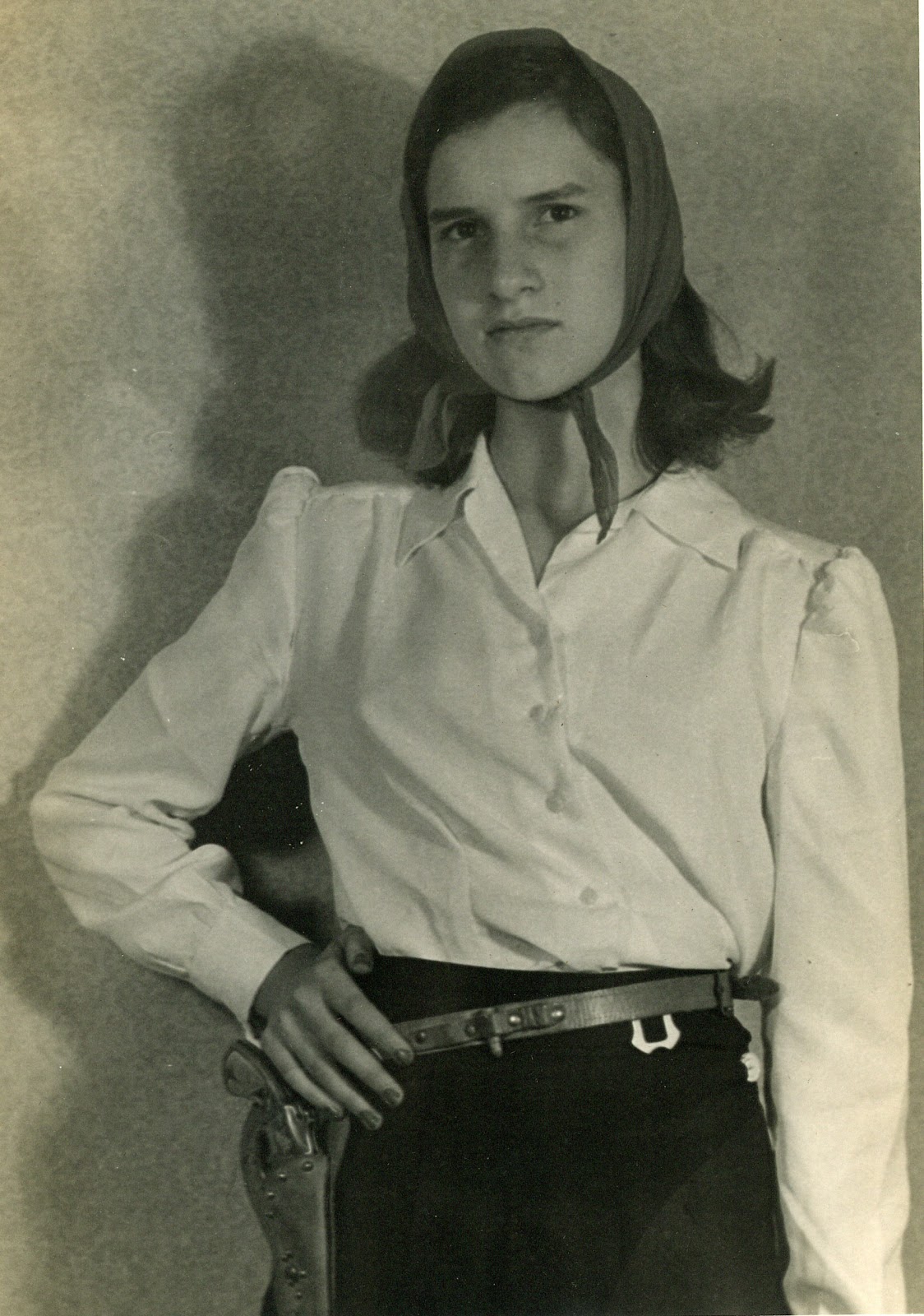
There was a new sheriff in town.


June as a western gunfighter for Halloween,
circa 1944.


Trick or Treat!

Countdown:  Correspondence resumes in 9 days.

© 2010 Lee Price

Friday, October 29, 2010

Groceries and Art School

After completing his Navy service in 1947, Art returned to Southampton and life in his parent’s house.  He found a job working at Roulston’s grocery store, which was managed by Rodney Pierson, a distant relative.  Art was a dependable hard worker.  He
Pencil sketch of a dog by Art Price.
Note grade of B+ above name.
handled all chores that needed to be done at the store including waiting on customers, butchering, mopping and cleaning, and stocking the shelves.

Art enrolled in the Partida School of Arts, located in Southampton at 18 Cameron Street.  Elena Partida founded the school with her husband Allan Harris to teach art, music, and dance.  Known by her students simply as Partida, she served as Art’s teacher as he studied oil painting, watercolor, drawings, composition, and life drawing.  Her husband taught the music and dance classes (which were not of interest to Art).

Once or twice a week, Art would attend his art lessons with Partida, working on his sketching and oil painting skills.  On other nights, he would go to the movies or spend an evening out with the boys.

(On Sunday, Happy Halloween!)

Countdown:  Correspondence resumes in 11 days.

© 2010 Lee Price

Thursday, October 28, 2010

First Year at Traphagen (1948-49)

Filling in with some background information during a letter-writing hiatus from October 6 to November 9, 1949, as June recuperates at the hospital from a ruptured appendix…

June finished her year at Pembroke in spring 1948 and never returned.  With her acceptance to the Traphagen School of Fashion, she found an apartment on 96th Street in New York City, going in on it with four roommates, including friends Shirley Stahl and Jane Hastings.  From this apartment, she took the subway to the Traphagen School of Fashion at 1680 Broadway, between 52nd and 53rd Streets.

Ethel Traphagen (1882-1963) opened the Traphagen School of Fashion in 1923 to promote fashion ideas that she popularized in books such as Costume Design and Illustration, published in 1918.  The school gained a reputation for its cutting-edge ideas, including the promotion of shorts and slacks as women’s wear. 

June's sketch of
a woman in pants.
In 1948, the school offered courses in fashion drawing, illustration, life drawing, design, forecasting, textile design, fabric analysis, interior decoration, window and counter display, fashion journalism, clothing construction, draping, pattern-making, grading, dressmaking, remodeling, millinery, and glove and bag making.  In her sixties, Ethel Traphagen was still an imposing presence at the school while June was attending. 

June tended to procrastinate on her Traphagen assignments – hardly a surprise considering all the distractions of Manhattan – but she was a good student with real talent.

Sketches by June of women in pants.


(On Friday, Art returns home…)

Countdown:  Correspondence resumes in 12 days.

© 2010 Lee Price