Tuesday, July 26, 2011

The Little We Know About the Proposal


For this entry, we leap ahead from the summer of 1950 to winter 1950.

According to a letter from June 1951, Art and June became engaged on Thursday, December 14, 1950.

Unfortunately, there are no family stories and no written accounts that describe the engagement.

We do know this:  We know that Art proposed and that June said yes.

And we know that this was the engagement ring.


(For Thursday – Six months later, Art is hospitalized.)

© 2011 Lee Price

Monday, July 25, 2011

A June and Art Photo Gallery


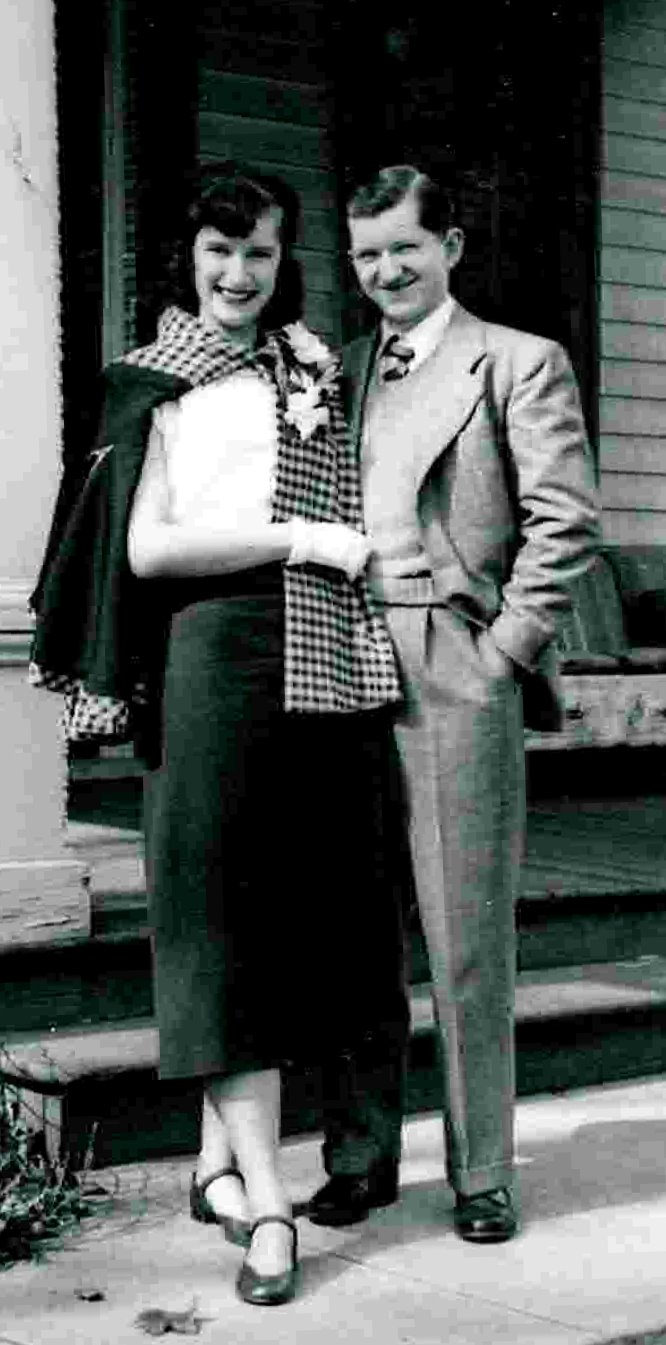
Pictures of June and Art together in the late 1940s and early 1950s:


(Tomorrow – The proposal.)

© 2011 Lee Price

Friday, July 22, 2011

The World of September 1950


June at the beach.
Skipping ahead to the slightly cooler month of September 1950, we begin building to a big event by first setting the scene.  This was the world that June and Art were living in:

Harry Truman was President.

The Korean War continued to rage on.  September 1950 was the month that U.S. Marines landed at Inchon and and recaptured Seoul after two weeks of hard fighting.  The draft was reactivated this month.

General George Marshall was sworn in as Secretary of Defense.

Joe DiMaggio was the first player to hit three home runs in a game at Griffith Stadium.

Mort Walker’s “Beetle Bailey” comic strip debuted.

The following people made the cover of Time:  Strategic Air Commander Lt. General Curtis LeMay, Admiral Arthur Radford, Berlin’s Mayor Ernest Reuter, and General O.P. Smith.

The following movies were popular in the theaters:  Summer Stock with Judy Garland and Gene Kelly, The Black Rose with Tyrone Power, Tea for Two with Doris Day and Gordon MacRae, The Fuller Brush Girl with Lucille Ball and Eddie Albert, My Blue Heaven with Betty Grable and Dan Dailey, and Mister 880 with Burt Lancaster and Edmund Gwenn.

The most popular show on television was Texaco Star Theater with Milton Berle on Tuesdays at 8, the second most popular was the Philco Television Playhouse on Sundays at 9, and the third was Fireside Theater on Tuesdays at 9 (doubtless benefiting from its position following Milton Berle).

And “Goodnight, Irene,” performed by The Weavers, was unavoidable on the radio that month.

(For Monday – June and Art romance in pictures.)

© 2011 Lee Price

Wednesday, July 20, 2011

The Shanghai Address, Part 3 of 3

Pencil sketch of Shanghai by Art Price.

(Continued from yesterday... This is the conclusion of a speech that Art presented at a Southampton Methodist women’s club sometime during the second half of 1950.)

It was against the rules for anyone to go on liberty in Shanghai alone.  I always went with this buddy of mine and usually there were 3 or 4 more of us.  Even then we never went in the old Chinese section or even down a side street at night.  Plenty of sailors out alone with too much to drink ended up in the river.  Plenty of Chinese would murder just for the value of the clothes a sailor wore.

I saw the body of a Chinese in that river, the Huangpu, and it wasn’t pretty.  It was wedged in between the dock at N.O.B. and a ship tied up there.  No one paid much attention to it and after 3 or 4 days the Chinese police got around to taking it out.  It was a coolie so no one cared who he was or how he died – one more or less didn’t make any difference to them.

Dinner on board the ship.  Pencil sketch by Art Price.
They only well fed children I saw while there were from an orphanage.  The Navy gave a Christmas party for 100 of them and I was drafted to work at it.  They were toddlers or up to older girls who looked after the younger ones.  The woman
in charge was also Chinese.  They gave the Christmas story in Chinese along with folk dances, etc.  I wish I could say it was a Methodist orphanage but I really don’t know what organization ran it.

I’ve just told you some of the things I saw in Shanghai.  There were other more sordid things going on in that city I’d better not tell.  There’s certainly plenty of room for Christianity there but it’s hard to teach a starving child not to steal.  It seems impossible that anything can be done for them when you’ve seen them but maybe it can.


Ships at anchor in Shanghai.

(Friday – Setting the stage:  September 1950.)

© 2011 Lee Price

Tuesday, July 19, 2011

The Shanghai Address, Part 2 of 3

Art's charcoal sketch of a child beggar in Shanghai.

(Continued from yesterday... This is the second part of a speech that Art presented at a Southampton Methodist women’s club sometime during the second half of 1950.)

The docks were haunted by thousands of children.  At chow time, they would stand alongside the ship and shout, “No momma, no poppa, no chow chow,” with tin cans in their hands, but if you felt sorry and gave one of them something you were immediately besieged by hundreds of them.

The gangway watch with a .45 automatic, an
officer waving a fire ax, and a mob of hungry
children.
One time the cook on the ship came out of the galley and went to a bin that was on deck to get some apples.  The kids on the dock spotted him and a mob of them tried to come on board shouting for chow chow.  The gangway watch with his .45 automatic and an officer waving a fire ax kept them from overrunning the ship.

When we went on liberty in the city there were always crowds following you trying to sell things.  One thing they seemed to think no sailor should be without was a leather blackjack, and maybe they were right.  One time when my buddy and I were walking down Nanking road, one of the principal streets, we stopped to look at a little carved chest one of the peddlers was trying to sell us.  In a minute, we were surrounded by a mob.  I knew what that meant in Shanghai and grabbed for my wallet.  There was a little hand in my pocket along with it, a kid no more than 4 or 5 years old was picking my pocket.  We both got out of that crowd in a hurry.

To be continued...

Art (on the right) with two friends in Shanghai.

(Tomorrow – part three of Art's speech on Shanghai.)

© 2011 Lee Price

Monday, July 18, 2011

The Shanghai Address, Part 1 of 3

Art's pencil sketch of some Navy friends.

The following is a speech that Art presented at a Southampton Methodist women’s club sometime during the second half of 1950.

Art with a monkey on his
shoulder that he cared for
while in Shanghai.  It was
a tradition on the ship for
the Quartermaster to take
care of the monkey.  Art
was not overly fond of his
temporary pet.
I was in Shanghai in December of 1945 and January of 1946, but I don’t think the Chinese I saw there would be typical of all the Chinese people.  At least, I hope not.  I was at the Naval Operating Base there and later on board a ship tied up along the riverfront down the river from the city proper.  Most of the people I saw were the ones who lived right on the river.  You’ve probably heard of the Shanghai waterfront where hundreds of thousands live on sampans all their lives.  The slips in the river were constantly surrounded by these people, begging or trying to sell us souvenirs.

There was one family that lived on their boat at the stern of the ship I was on.  For two weeks, they stayed there simply to pick up the garbage that was thrown out of the galley.  The cooks would lower the garbage can to them on a rope, and they would dump it into boxes or anything they had. There were two women, a girl, and a baby living on that boat.

Art's pencil sketch of
a beggar in Shanghai.
The people were so terribly poor they would pick up anything that floated in the river: paper, sticks, boards, anything at all.  And if it didn’t float, there were other boats that dragged the bottom with long rows of fish hooks tied to sticks to pick up scrap iron off the bottom.

While on this ship, an LST (Landing Ship, Tank), they had the hull chipped and painted, from bow to stern, by coolies.  In the states, it probably would have cost thousands to have civilians paint that ship.  There it cost about $20 and that included a contractor’s fee.

One day while the coolies were on board, we had some rice for chow that the ship had picked up in Shanghai.  It was so alive with worms you could hardly see the rice, but before anyone could throw their rice over the side the coolies took it and ate every bit of it.

In this country, it’s hard to realize how strong the caste system is in China and other countries.  At N.O.B., the Naval Operating Base, they had hundreds of them working, young boys and old men worked side by side with no thought other than that they would always be coolies, as their fathers had been and their children would be;  all they ask is enough to eat to stay alive.  They were laying a cement floor on the second floor of a big warehouse converted into our barracks.  All day long they trudged up and down the stairs with half of a 50-gallon drum slung between them filled with cement.  The stairs in all the warehouses were built with steps only two or three inches high so coolies could carry heavy loads up and down them.

To be continued...


This may be the LST mentioned in the speech.

(Tomorrow – part two of Art's speech on Shanghai.)

© 2011 Lee Price

Saturday, July 16, 2011

Images of Roulston's

Art working at Roulston's, circa 1950.

A couple more pictures have turned up of Roulston’s, where Art worked as a grocery clerk during his courtship with June.  Located on Main Street, the Southampton Roulston’s was one of hundreds of Thomas Roulston & Sons chain grocery stores located in Brooklyn, Queens, and Long Island.  The chain was headquartered in Brooklyn and the oldest stores dated back to the 1880s.  In the 1940s, the Southampton store was managed by Rodney Pierson, a distant relative of Art’s.

Apparently, Art worked briefly at Roulston’s prior to his time in the Navy.  When he returned to Southampton in 1947 after his service as a Navy Quartermaster, he went back to working for Rod Pierson at Roulston’s.

In August 1944 (when Art was 17 years old), Rod Pierson wrote the following recommendation for Art, possibly connected with Art’s looming service in the Navy and/or his application for Quartermaster training:

August 8, 1944
Southampton, NY

To whom it may concern:

Arthur W. Price has been in my employ for the past two months during which time I have found Arthur to be honest, upright, and conscientious in every respect.  I do not hesitate to recommend Arthur very highly.

F. Rodney Pierson


Another image of Roulston's from the time when Art
was working there.


An image of Roulston's, circa 1920.  A special thank you to the
Southampton Historical Museums and Research Center for this delightful
image of old Southampton!

(For Monday – Art's 1950 speech to a women's club about his experiences in Shanghai.)

© 2011 Lee Price