Friday, July 29, 2011

The Vital Statistics

With the wedding tentatively scheduled for September 1, 1951, Art decided to address a long-standing health problem.  He was admitted to Presbyterian Hospital in New York City on June 12 for an operation to address the pain in his left knee.

Tuesday, June 12, 1951

Presbyterian Hospital
168 Street, 5 Floor
New York, NY

Dear June:

Art on the beach, circa 1950.
His left knee had been hurting
him for years.
It’s so long since I wrote a letter that I don’t know where to begin.  Maybe I’ll tell you the vital statistics again.  Visiting hours are from 2 to 8.  I’m in Room 15 on the fifth floor.  This guy in the room with me seems to have quite a lot of pain.  He’s in a cast from his toes to his thigh.  They did something with his ankle.

My mother is coming on Thursday and plans to stay here for the operation on Friday afternoon.  I doubt if she’s here for the weekend though.  I’ve already had a few needles shoved in me and my leg shaved.

I’m looking forward to seeing you on Sunday, and I’ll call you every day that I can.  I love you so much, darling.  Your picture’s right next to my bed on the nightstand.

Be careful coming into the city.  Good night now, darling.

All my love,

Art

(Tomorrow – Asking a bridesmaid.)

© 2011 Lee Price

Thursday, July 28, 2011

Art Hospitalized

Presbyterian Hospital in New York City.

“Art, how is your knee now?  Please, even if it is feeling better, keep doctoring it – after all, I’m hoping to dance the next time we go out.”
                                                                                June Anderson
                                                                                Letter to Art Price, Oct. 1, 1949

June and Art were engaged sometime in fall 1950.  Now we’re leaping ahead approximately nine months to June 1951.  June and Art had tentatively planned a wedding for early September but no definite date had been set yet.  Art decided to take care of an ongoing problem first.

Art had a bad left knee.  He’d lived with it for years but the pain seemed to be increasing recently.  His family doctor referred him to specialists at Presbyterian Hospital in New York City, and Art was admitted to the hospital in mid-June 1950.  Considered one of the finest hospitals in the country, Presbyterian Hospital was located on 168th Street in Washington Heights, a Manhattan neighborhood located at the northern tip of Manhattan.

During the winter and spring months when June was working in Westhampton and Art in Southampton, they saw each other frequently and therefore there was no need for their earlier letter writing to continue.  Then Art left town to check into the hospital.  Separated again, the letter writing resumed.  This time, however, Art was in New York City and it was June who waited impatiently for him to return home to the eastern end of Long Island.

(Tomorrow – the letter writing resumes.)

© 2011 Lee Price

Tuesday, July 26, 2011

The Little We Know About the Proposal


For this entry, we leap ahead from the summer of 1950 to winter 1950.

According to a letter from June 1951, Art and June became engaged on Thursday, December 14, 1950.

Unfortunately, there are no family stories and no written accounts that describe the engagement.

We do know this:  We know that Art proposed and that June said yes.

And we know that this was the engagement ring.


(For Thursday – Six months later, Art is hospitalized.)

© 2011 Lee Price

Monday, July 25, 2011

A June and Art Photo Gallery


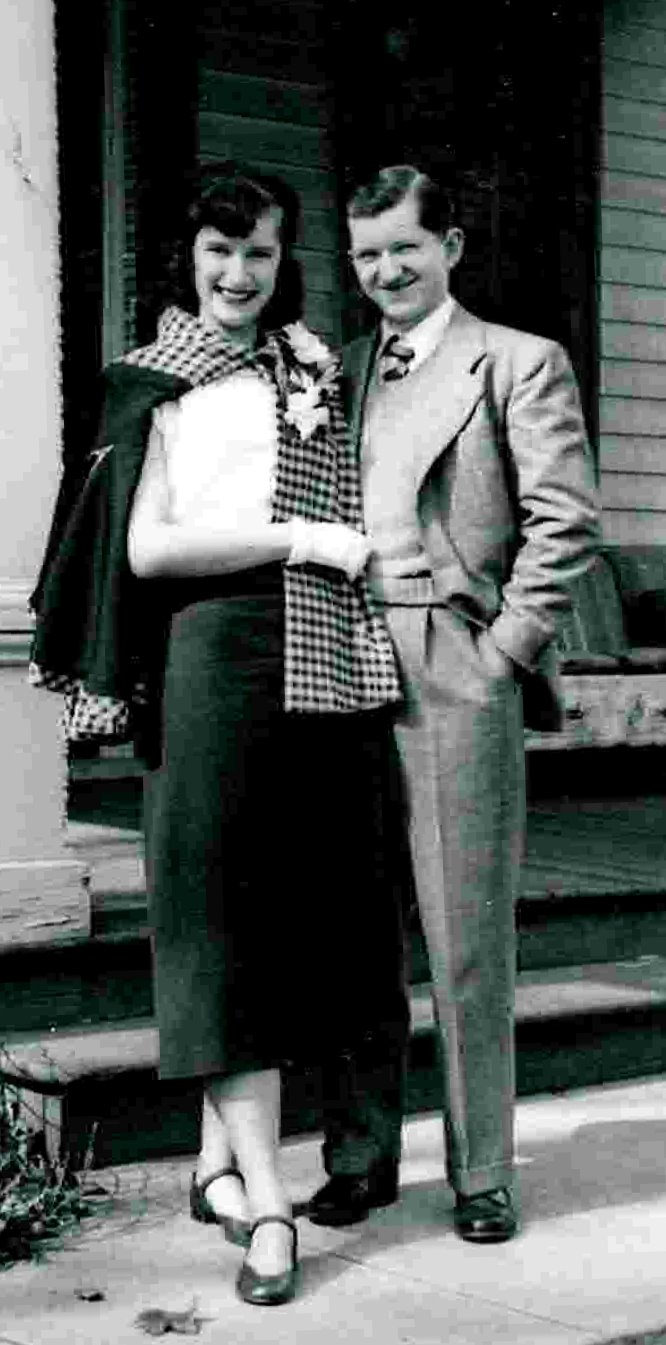
Pictures of June and Art together in the late 1940s and early 1950s:


(Tomorrow – The proposal.)

© 2011 Lee Price

Friday, July 22, 2011

The World of September 1950


June at the beach.
Skipping ahead to the slightly cooler month of September 1950, we begin building to a big event by first setting the scene.  This was the world that June and Art were living in:

Harry Truman was President.

The Korean War continued to rage on.  September 1950 was the month that U.S. Marines landed at Inchon and and recaptured Seoul after two weeks of hard fighting.  The draft was reactivated this month.

General George Marshall was sworn in as Secretary of Defense.

Joe DiMaggio was the first player to hit three home runs in a game at Griffith Stadium.

Mort Walker’s “Beetle Bailey” comic strip debuted.

The following people made the cover of Time:  Strategic Air Commander Lt. General Curtis LeMay, Admiral Arthur Radford, Berlin’s Mayor Ernest Reuter, and General O.P. Smith.

The following movies were popular in the theaters:  Summer Stock with Judy Garland and Gene Kelly, The Black Rose with Tyrone Power, Tea for Two with Doris Day and Gordon MacRae, The Fuller Brush Girl with Lucille Ball and Eddie Albert, My Blue Heaven with Betty Grable and Dan Dailey, and Mister 880 with Burt Lancaster and Edmund Gwenn.

The most popular show on television was Texaco Star Theater with Milton Berle on Tuesdays at 8, the second most popular was the Philco Television Playhouse on Sundays at 9, and the third was Fireside Theater on Tuesdays at 9 (doubtless benefiting from its position following Milton Berle).

And “Goodnight, Irene,” performed by The Weavers, was unavoidable on the radio that month.

(For Monday – June and Art romance in pictures.)

© 2011 Lee Price

Wednesday, July 20, 2011

The Shanghai Address, Part 3 of 3

Pencil sketch of Shanghai by Art Price.

(Continued from yesterday... This is the conclusion of a speech that Art presented at a Southampton Methodist women’s club sometime during the second half of 1950.)

It was against the rules for anyone to go on liberty in Shanghai alone.  I always went with this buddy of mine and usually there were 3 or 4 more of us.  Even then we never went in the old Chinese section or even down a side street at night.  Plenty of sailors out alone with too much to drink ended up in the river.  Plenty of Chinese would murder just for the value of the clothes a sailor wore.

I saw the body of a Chinese in that river, the Huangpu, and it wasn’t pretty.  It was wedged in between the dock at N.O.B. and a ship tied up there.  No one paid much attention to it and after 3 or 4 days the Chinese police got around to taking it out.  It was a coolie so no one cared who he was or how he died – one more or less didn’t make any difference to them.

Dinner on board the ship.  Pencil sketch by Art Price.
They only well fed children I saw while there were from an orphanage.  The Navy gave a Christmas party for 100 of them and I was drafted to work at it.  They were toddlers or up to older girls who looked after the younger ones.  The woman
in charge was also Chinese.  They gave the Christmas story in Chinese along with folk dances, etc.  I wish I could say it was a Methodist orphanage but I really don’t know what organization ran it.

I’ve just told you some of the things I saw in Shanghai.  There were other more sordid things going on in that city I’d better not tell.  There’s certainly plenty of room for Christianity there but it’s hard to teach a starving child not to steal.  It seems impossible that anything can be done for them when you’ve seen them but maybe it can.


Ships at anchor in Shanghai.

(Friday – Setting the stage:  September 1950.)

© 2011 Lee Price

Tuesday, July 19, 2011

The Shanghai Address, Part 2 of 3

Art's charcoal sketch of a child beggar in Shanghai.

(Continued from yesterday... This is the second part of a speech that Art presented at a Southampton Methodist women’s club sometime during the second half of 1950.)

The docks were haunted by thousands of children.  At chow time, they would stand alongside the ship and shout, “No momma, no poppa, no chow chow,” with tin cans in their hands, but if you felt sorry and gave one of them something you were immediately besieged by hundreds of them.

The gangway watch with a .45 automatic, an
officer waving a fire ax, and a mob of hungry
children.
One time the cook on the ship came out of the galley and went to a bin that was on deck to get some apples.  The kids on the dock spotted him and a mob of them tried to come on board shouting for chow chow.  The gangway watch with his .45 automatic and an officer waving a fire ax kept them from overrunning the ship.

When we went on liberty in the city there were always crowds following you trying to sell things.  One thing they seemed to think no sailor should be without was a leather blackjack, and maybe they were right.  One time when my buddy and I were walking down Nanking road, one of the principal streets, we stopped to look at a little carved chest one of the peddlers was trying to sell us.  In a minute, we were surrounded by a mob.  I knew what that meant in Shanghai and grabbed for my wallet.  There was a little hand in my pocket along with it, a kid no more than 4 or 5 years old was picking my pocket.  We both got out of that crowd in a hurry.

To be continued...

Art (on the right) with two friends in Shanghai.

(Tomorrow – part three of Art's speech on Shanghai.)

© 2011 Lee Price